September 21, 2013

Cover Crops in the Fall Garden

I have three species of cover crop growing in my garden right now.  I like growing winter cover crops rather than just covering the garden with leaf mulch for several reasons:
  • Grassy cover crops grow extensive root systems that protect the soil from erosion.
  • The plants uptake soil nutrients that otherwise would be lost to leaching.
  • They inhibit weeds.
  • The tall cover grasses increase soil moisture by trapping snow and shading the soil.
  • Legume species produce their own nitrogen fertilizer.
  • Cover crops increase levels of organic material in the soil.
  • They're cheaper and easier than hauling in manure or compost and serve the same functions.
  • I like looking out my window in mid-winter and seeing plants in my garden!
 
A well-established bed of rye and vetch sown after the potatoes were harvested.
I've sown winter rye and hairy vetch in most areas where I've pulled out the summer vegetables.  Rye and vetch are the most winter hardy cover crops for New England and will grow until the deep cold of January and February.  Vigorous growth will resume in the spring.  The spring growth will produce an amazing amount of biomass from the rye, and the vetch (a legume) will increase the fertility of the soil through nitrogen fixation.  The rye/vetch mix will have to be mown and tilled under in the spring.  The major drawback of rye is that the residues will inhibit the growth of other plants for at least three weeks after tilling in the rye.

Rye and vetch sprouting beneath the fall lettuce patch.
The tomatoes, peppers, and eggplant were undersown with oats around mid-July to provide a living mulch.  I'll pull these veggies once the first frost hits, leaving behind a well-established oat cover crop. The oats will die over the winter and leave a nice mulch on the soil to protect against runoff during the spring rains.  I can either plant spring crops directly through the mulch or till it under.  Similarly, I planted rye and vetch beneath some of the fall veggies like lettuce to let the cover crops get a head start.  I typically plant the winter cover crops no later than the second week of September; any later and the tender young plants will not fare well against the early frosts.

Oats were sown beneath the tomatoes in mid-July.
Next year I will experiment with more mid-season undersown cover crops using legumes such as dwarf white clover.  The clover will act as a living mulch that should reduce the slug problems I had this year using leaf mulch beneath the plants. 


September 18, 2013

The Difference a Day Makes: An Overnight on the Twin Range


Johnny G. on the Bondcliff Trail hiking south to camp.
A few months ago, I was working on a project in the basement and glanced at my backpacking and camping gear sitting unused in a musty storage bin. "Geez, I haven't been on a proper backpacking trip in about three years, what a shame," I lamented to myself. Backpacking, you see, is one of my absolute favorite outdoor activities. Of all the outdoor sports, I consider backpacking to be the most "pure" because of the inherent simplicity of walking in the woods, the self-reliance of carrying your life necessities on your back, and the enhanced situational awareness of navigation, weather, body, and trail conditions. Of course, backpacking trips are the hardest to come by these days precisely because of the time needed to pull one off (such are the compromises of being a parent). That, and there are few people out there who are willing to subject themselves to such "recreation".

Johnny G. near the summit of Mt. Guyot.
So, much to my delight, a planned family day hike in the White Mountains of New Hampshire morphed into an overnight excursion with my cousin Johnny G, a participant in one of the famed Bolton backcountry ski trips. The plan was simple; the family, Johnny, and I hiked the 2.8 miles to the Appalachian Mountain Club's Zealand Hut via the Zealand Trail. For those of you hiking with small children or, ahem, older folks, the hike to Zealand Hut is moderately difficult with rewarding views of mountain marshes, streams, waterfalls, and Zealand Notch. Not to mention, you can buy hot food and drink at the Zealand Hut and have yourself a proper sit-down potty break if the occasion calls for it. After lunch at the hut, Johnny and I parted ways with the family and continued another 5 miles along the Twin Range to the Guyot campsite on the southeast flank of Mt. Guyot.

I love hiking in the fog. I estimate that two out of three White Mountain hikes I've done in the last 3 years have been shrouded in mist…a testament to the stormy temperament of these mountains. Day 1 of the Twin Range expedition kept the foggy streak alive. The fog obscures the obvious vistas and forces us to look elsewhere for inspiration…those intricacies that go unseen on clear days when sweeping mountain views capture our attention. The movement of the wind, normally invisible to the human eye, is portrayed in swirling droplets that pass through the trees with a whisper. The scent of pine pitch, strangely resembling cotton candy, is somehow amplified by the mist. These sensations haunt and excite me, and they are worthy reasons to hit the trail on less than perfect weather days. I reflected on similar sentiments in my blog post about a hike on Mt. Moosilauke almost exactly one year ago.
Pemigewasset Wilderness.
As the family hiked back to the car for a comfortable evening of hot-tubbing and Web TV, Johnny and I forged through the fog, passing by the cloud-choked Zeacliff view, the imminently forgettable forested summit of Mt. Zealand (but one of New Hampshire's 48 peaks over 4,000 feet above sea level), and the rocky moonscape of Mt. Guyot. The trail gave us a nice blend of rocky, heart-thumping climbs and mellow ridge traverses, perfect for conversation, observation, and photography. And then there was the nerve-jangling rush of flight from a disturbed spruce grouse! As the day grew long in tooth and our legs weary, the trail brought us to the Guyot campsite. The friendly (half stoned) caretaker informed us that the tent platforms were full and offered us space in a crowded lean-to or an overflow tent site that was in the path of a water diversion ditch. Thanks, but no thanks. We elected to try our luck at a tent site on the ridge between Mounts Guyot and Bond…windier, but without the human commotion of the main campsites. After a quick dinner and beverage, we retired to the tent as daylight faded. That evening, the ridge was host to the tumultuous arrival of a cold front that evicted the fog from the mountains. The winds raced down the ridge from Guyot to Bond and onward, sounding like automobiles on a highway overpass. Our tent, sheltered by the thick evergreens, was not affected by the wind and offered us a unique vantage to the readjusting pressure gradients above us. 

Zeacliff, Day 1
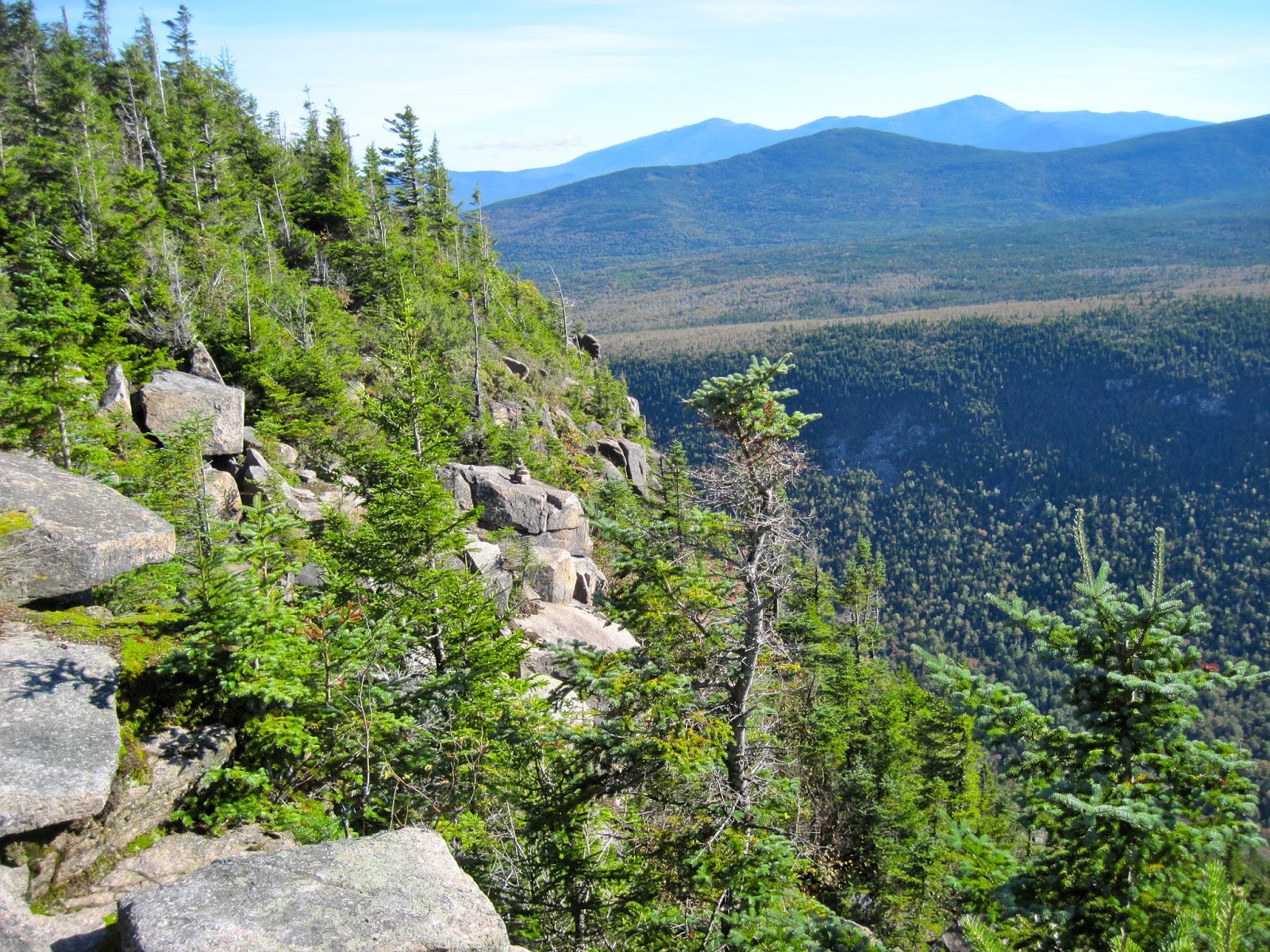
We awoke just prior to sunrise over the Willard Range to the east. The clear, dry air of the cold front had swept the Whites free of the mists that defined the previous day. What a difference a day makes! We struck camp after a quick breakfast and gained the summit of Mt. Guyot around 8AM. We were gifted with sweeping views at every point of the compass…North and South Twin to the northwest, Mt. Lafayette and the Franconia Range to the west, Bond and West Bond to the south, and Mt. Washington and the Presidential Range to the east. Just as impressive was the sweeping view of the vast forested Pemigewasset Wilderness. And to top it all off, the valleys were filled with morning fog that hid any evidence of humanity, save for the towers on the summit of Mt. Washington! Wild!

Zeacliff, same vantage point, 24 hours later.
A few short hours of pleasant hiking brought us to Zeacliff, where our view of Zealand Notch had been rebuked by fog just 24 hours earlier. The Pemi Wilderness sprawled out beneath us, framed to the east by the rock walls and talus slopes of Whitewall Mountain and to the south by the imposing massif of Mt. Carrigain. We watched a raven ride a thermal, gaining thousands of feet of altitude in less than a minute with nary a wing flap. We stood on the cliff, spellbound by the panorama, too engaged in our surroundings to remember to take off our packs for a brief rest. The utter solitude was punctuated only by the distant roar of the many cascades that drain the steep mountainsides. Zeacliff was the exclamation point to a great hike and a fitting reward for our fogbound travels.
The Twin Range expedition was a quick hit of wilderness that stoked the flames of passion for outdoor adventure. I once again shouldered a pack of trusted camping gear and wandered into the woods in search of… 

Absolutely Nothing

Low tide?
That's right!  Nothing!  An interesting development in my outdoor experiences! In years past I put a lot of emphasis on these adventures to somehow find or define myself, or prove something to myself and others. I think that even the Moosilauke hike a year ago was in a similar vein…the tumultuous account of that trip was a reflection of a transitional time in my life. But now that parenthood has settled in and my perspectives have changed, I find myself asking far less of my outdoor trips. I simply want to get out and enjoy them. By stripping away such expectations of "meaning", I leave myself more receptive to serendipity, and I come out of the woods feeling refreshed, and CALM.  Calm - there's a term I would never use to describe myself when I was in my 20s!


So, despite my lack of expectation (or maybe because of it), the woods once again taught me a lesson. 

Thanks for a great hike, Johnny.

 
Safe travels, all!


Backpacking Resources
 
The essential White Mountain hiking guide:


Thinking about getting into backpacking? Great! Read this book first before you head to REI or EMS and spend a fortune to outfit yourself with the newest backpacking gear. (Better yet, click on the Amazon and eBay links to buy gear and support the Woods Hippie!) The authors take a humorous, yet no-nonsense approach to backpacking equipment and techniques. Even experienced trampers will find some useful nuggets of wisdom.


Search for backpacking gear on eBay:


September 17, 2013

Garden Successes and Failures

2013 was an interesting garden year here in central Connecticut.  A lingering and cold spring warmed into a very dry May that was classified as a moderate drought.  June brought heavy rains to the party, followed by a scorching July.  August was a blessing of a month; the warm days and cool nights enveloped us in the glorious remnants of summer while hinting at the splendor of the upcoming autumn.

Of course, the only thing normal about weather is that it is never normal, and we gardeners simply take it in stride and plant many varieties in the knowledge that some will fail and some will succeed.  So, I present to you, select garden successes and failures of 2013!

The Good
Delicious.
Eggplant!  Oh, the glorious eggplant!  This was the first year I grew the purple globes, and I was rewarded with two plants that just produced and produced some more.  The variety was Galine.  I'm growing these guys again next year.

Heirloom tomatoes...I grew Cherokee Purple and Pink Brandywine.  Cherokee wins hands-down for flavor, color and texture over any other variety that I have grown.  I will confidently state that one of my mid season Cherokees was the finest tomato I have ever eaten.  It totally ruined me in that I will never enjoy another store bought tomato for the rest of my life.  This tomato will be the garden dragon that I will chase for years to come.  Yup, that good.  Also, the Honeydrop Cherry tomatoes (not heirlooms) made a fine showing for the second season in a row with an endless supply of sweet orange/yellow fruits that were always eaten before they made it into the kitchen.


Snap beans, lettuce, carrots, cucumbers, and broccoli (finally!) produced very well this year.

The Bad (that's harsh...let's just say The Mediocre!)
The garlic crop came in early, small, and somewhat bland.  I can't complain because I received free seed last year.  I did make a sweet garlic braid, which I count as a success!

The Garlic Whisperer.
Spring-planted turnips performed very poorly, but the July planting made it to the table in fine fashion.  The rutabagas and cabbage took forever to get going, but the rains of June helped spur growth, and the results were quite tasty.

My first rutabaga.
I will not grow Cosmonaut Volkov tomatoes again.  The plants were slow to mature and prone to blight, and the fruits were somewhat bland with a weak red color.  That said, they were tastier than 95% of supermarket tomatoes, so it's all relative, folks.  But now I'm chasing that dragon, you see, and I have no room in my garden for this.  Life's too short to drink cheap beer and eat shitty tomatoes.

The Ugly
Peas, golden beets, and sweet corn were abject failures.  I made multiple plantings of each and experienced near total germination failures.  I understand the peas.  The poor seeds were subject to cold and rain and then total heat and drought.  By June, I mercifully pulled the few plants that grew and sowed a cover crop of buckwheat.  One or two plants produced peas.  Naturally, they were the sweetest and most tender peas I have ever grown...a pure tease of what could have been.

Rainbow chard...a pretty picture in the "ugly" paragraph.
I had a tough year for summer squash.  I ate exactly one patty pan squash and one zucchini before the plants fell prey to vine borers and powdery mildew.  Last year I was overrun with these fruits.  Funny how these things cycle from year to year.

My peppers all got worms before they ripened.  Oh well.  There is always next year.

The Take Home Message
I learned so much in the garden this year.  I tried growing eggplant, onion, leeks, parsnips, rutabaga, and turnips for the first time and got tasty harvests of each.  I finally beat the weeds by using hoeing techniques I read about in Eliot Coleman's essential garden book, The New Organic Grower.  I spent about 20 minutes a month weeding my 400 square foot garden, without having to bend over or pull a weed by hand.  I improved irrigation techniques and relieved a lot of drought stress that I believe my garden has suffered in years past.  I experimented with custom-made fertilizer mixtures that stemmed from a laboratory analysis of the nutrient content of my soil. I'm pretty excited for next year...I've expanded my garden by another 560 square feet and tilled in 750 square feet of my grandparents' backyard.  It's all growing a cover crop of rye and vetch right now and will be part of next year's grand experiment in gardening!  Stay tuned!

Some of it looks perfect.  Some of it looks funky.  But it's all organic and all tasty!


September 11, 2013

Garden Technology

I constructed some very simple garden tech this summer.  This equipment has really helped me out and has set the stage for next year's improvements.

My favorite tool this summer was a simple impulse sprinkler that I hose-clamped to a metal sign post.  I spent the money on an all-metal sprinkler because I was tired of breaking the crappy plastic ones.  The added height of the sign post allowed the sprinkler to cover more area with fewer moves.  That said, I found the effective watering radius to be about 15 feet.  I used a plastic rain gauge to accurately measure the amount of water I was putting on the garden.  I aimed for 1 inch of water every 4-5 days.  The rain gauge, of course, measured rain, so I was able to tailor my irrigation in consideration of the natural rainfall during a given 4 day period.

Next year I would like to hook up 3 or 4 of these in series to irrigate the whole garden with minimal effort.  The disadvantage of the impulse sprinklers is that there are water losses to evaporation, it is reliant on chlorinated tap water, and the plant leaves get wet and are more susceptible to fungal diseases.  I'm not (yet) willing to invest in a drip irrigation system, but I might be temped if I can increase the capacity of my rainwater storage system.

Which brings me to my next piece of garden tech, my rain barrel!  I've had a plastic 55-gallon barrel sitting in the garage for years, and I finally got around the constructing a rain catchment.  I used an electric drill with a hole-saw to make the cutouts for the spigot and overflow.  I used an electric jig saw to cut out the opening for the downspout.  I used simple PVC piping for the overflow.  I purchased a brass hose bib (spigot) from Home Depot and a plastic bulkhead fitting from Tractor Supply.  The bulkhead fitting is the key to a watertight connection since it has rubber gaskets that make a tight seal to the barrel and is threaded to accept the spigot.  Don't try threading the spigot directly into the plastic barrel or it will surely leak.  The debris screen is a colander that was sacraficed for the cause.  I assembled this in about 30 minutes.


I used the rain barrel mostly for field-washing vegetables from the garden (always followed by a tap water rinse in the kitchen), irrigating the blueberry bushes, washing out the compost bucket, and hand washing after yard work.  It would be easy enough to link together several barrels to increase my storage capacity so that I could experiment with a no-pressure drip irrigation system in the garden.

Click on the images below to link to Amazon if you want to buy some of the components and tools to build your own rain barrel.  Find the plastic drum locally, if you can.  The shipping will cost more than the barrel.  Just make sure the drum hasn't held toxic materials!!!

Rain Barrel Components


The last bit of garden tech is decidedly low tech.  My old pallet compost bin rotted away, so I made up a new one with four pallets and some baling wire.  Wiring the pallets together was much faster than using screws, and allows me the flexibility to easily open up the bin to shovel out compost.


What garden tech made your gardening easier and more fun this summer?  Please share your innovations!

September 10, 2013

Making Biochar

One of my garden experiments this year was to make biochar to increase my soil's capacity to retain nutrients.  Soils have varying abilities to hold elements such as calcium, magnesium, phosphorous, potassium, copper, boron, zinc, and manganese that are necessary for healthy plants.  Imagine that soil is the (-) end of a big Energizer Battery.  Most of the chemical nutrients are the (+) end of the battery.  Soil with a lot of stable organic material (humus), clay, or biochar (a fancy term for finely-ground charcoal) has more (-) battery ends and attracts more (+) nutrients and prevents the nutrients from leaching away during heavy rains.  Plants, a.k.a. nature's biochemical wizards, obtain their nutrition from this soil battery.  This whole battery concept is known as the soil's Total Cation Exchange Capacity (TCEC - a topic for another day...and for hardcore science/garden nerds).  It's all about nutrient dense gardening.  For more reading on TCEC and soil nutrients, check out Steve Solomon's book The Intelligent Gardener: Growing Nutrient Dense Food.  I sent a soil sample to an agricultural laboratory and found that my garden is a pretty weak battery.

So, in addition to the regular applications of compost, I will add biochar to the garden next season as part of my ongoing effort to build powerful soil.  My source of charcoal is the leftover briquettes from my last barbecue.  I grind the briquettes into a fine powder using a rock and store the resulting biochar in a 5-gallon bucket.


I also have quite a bit of tree bark left over from woodsplitting.  The bark makes a nice campfire and produces ample charcoal that is easy to grind (when fully extinguished, of course!).  I maximize the amount of charcoal by dousing the fire with water rather than letting it burn down to ash.  I think it's so cool that a byproduct from one operation becomes the input for another.  There's no waste...just resource cycling.


I layer biochar into the compost heap rather than adding it directly to the garden.  Based on my research, this step is critical.  Raw biochar has to be "charged" with nutrients and biological life in order to make it effective in the garden, otherwise it can inhibit plant growth for a year or two.  The compost heap is loaded with nutrients, bacteria, and fungi and is a great place to age the char for a year or two.


Biochar is also a simple way to sequester carbon, since the char molecules will persist in the soil for hundreds or thousands of years without releasing carbon dioxide to the atmosphere.  Pre-Colombian Amazonian farmers used biochar to fortify notoriously poor rain forest soils.  These ancient farmlands are still fertile as a result of biochar.  Let's see if it works in my garden!

September 9, 2013

Update

I haven't posted to this blog for nearly a year, but I haven't given up on it! Far from it; in fact, I have plans for a slew of new posts with a revised twist on the content. You see, the original incarnation of the Woods Hippie was a vehicle to use creative work to alleviate my discontentment with aspects of my life and a good excuse for some last outdoor adventures before fatherhood. Two years of parenting have exposed some (but not all) of those frustrations as selfish folly, but, more importantly, have taught me that the adventure continues even with a child in the fray. In the interim, I have become so deeply intrigued in gardening, homesteading, and permaculture that my life's mission, heretofore undefined, is moving confidently in those directions. I can't put a finger on the the whens, wheres or hows, but I intend to use the Woods Hippie format as a way to carve out this path. Of course, this blog will continue to serve as a creative outlet centered on outdoor wanderings (both with and without children) but with an added emphasis on gardening and suburban homesteading. What the hell is suburban homesteading, you ask?

 It's what happens when a guy (me) lives on a 1/4 acre city lot and pisses off his neighbors by converting half of his back yard to a garden...


the other half into a woodlot...


and dreams of the day when he can move to the country.

Please join my family and me as we pursue this adventure together!

September 29, 2012

The Only Plan Is...There Is No Plan

The constituency has been clamoring for another blog post, so here goes. 

The weekend in the woods ended before it even began.

No, not in the sense that time flies when you're having fun, but in that my hiking partner for a three day backcountry trip bagged out two days before departure.  Not unexpected, but the turn of events left me adrift for a way to dispense with a free weekend.  What transpired was a Woods Hippie wandering of the finest sort - an adventure of motorcycles, tempests, summits and spirit that was rampant in spontaneity yet rooted in familiar terrain.

Rowell's Bridge spans the Contoocook River in Hopkinton, New Hampshire.
At the urging of Mrs. Hippie, who was anxious to rid herself of a moody husband, I packed the motorcycle with a kit of essential camping and hiking gear.  With tent, bedroll, stove, and clothing in the saddlebags and gasoline in the tank, I struck out in search of new roads.  I would like to brag that I was unencumbered with preconceptions and expectations and set out on an adventure of pure whim, but the reality was that the trip didn't immediately take a form because of paralytic indecision on my behalf.

Brooding.  Where should I go?  Irritable.  How about here (points a finger to a random place on the map)?  Frustrated.  No, I don't really want to go there.  Resigned.  But why not?  In the end, I settled on riding north into New Hampshire to camp at a Forest Service campground in Waterville Valley where I would stage hike of the Tripyramids.  Okay, fine, fair enough, it was enough to motivate me to put up the kickstand and hit the starter switch.  Friday morning arrived and I bid the family adieu, two- and four-legged alike.  The ride, all 260 miles of it, passed pleasantly if not unremarkably, highlighted by the waning colors of summer's passing days.  The spring and summer flowers have long wilted, leaving behind weedy hedgerows of goldenrod and aster to hue the fields, and the maples and beeches have taken on a tired grey-green tone to their foliage - perhaps the earliest signaling of the resplendent carnival of color to come.

As the bike carried me to the southern gateway of the White Mountains, mere minutes from my intended bivouac, more changes.  I was a mere 45 minutes from my family's mountain retreat, complete with a hot tub, soft bed, and a bottle of cheap whiskey.  That, and twenty miles of the sweetest sweepers and twisties in New England.  (Not familiar with sweepers and twisties?  Buy a motorcycle, immediately!)  The aches in my shoulders and posterior that had been building all day suddenly diminished and I nudged the black Suzuki on a northwesterly tack alongside the Wild Ammonoosuc River, an unrecognized foreshadowing of the following morn when I would hike to her headwaters high on a mountainside.

Settled with drink in hand and music pulsing form the stereo, I opened the hiker's guidebook to peruse some trail options and unleashed rolling, unstoppable changes to the plan, this time not at the hand of indecision but rather as necessary reactions to impending weather - a powerful cold front that was forecast to be the turbulent arrival of fall in the White Mountains.  All at once the wide open day was framed by very real considerations - squalls in the high mountains are significant threats and riding motorcycles in the rain is just plain misery.

The plan...those rolling changes...which mountain to climb?  The necessities - a short ride from camp, quick hike to a tall summit, off the mountain before the storm hits, majestic scenery, and superlative physical challenge.

Anyone want to donate to the Buy the Woods Hippie a Better Camera Fund?
My mind wasn't fully made until I awoke in the pre-dawn hour.  Clouds streamed above at altitude and the lowlands were crowded with fog.  Fools stay in the hills in such weather, so this foolish boy climbed Mt. Moosilauke via the Beaver Brook Trail, a short, steep, and physical footpath.  The trail and brook are synonymous - often occupying the same space.  Primal cascades slide down a laceration in the woodland that has exposed the bedrock heart of the mountain.  Vivacious, tumbling, medieval.  After a steady, meticulous climb on slick rocks, I emerged from the ravine and ascended into the summit meadow.  The unrelenting fog sparked thoughts of the delicate dance of water and life.  Having just returned from the desert canyonlands of Utah, I was acutely aware of the biotic struggles to acquire this essential fluid.  And here, surrounded by billions of somehow perceivable vapor droplets suspended on the wind, I could almost sense the summit vegetation opening their stomata and drawing deeply of the moisture-laden air, obtaining from thin air the lifeblood long denied by the hot and dry summer season.  On this grassy peak the hydrologic cycle began, or ended, or simply was.  All this vapor condensing on rock, soil, and plant alike, with the smallest volumes merging in the subterranean pores to create a saturated body sufficient to supply the cascade deep into summer.  Rivers from clouds.  The swirling womb of the Wild Ammonoosuc River.

The view from the summit meadow.  I wouldn't have it any other way!
My early departure, eagerness to climb hard, and trepidation regarding the approaching storm found me on the summit at 10am.  Plenty of time to enjoy the rockpile, or so I thought.  Food, water, and added layers of clothing kept the moist, cooling winds at bay for a half hour at best until a chill crept into my bones and beckoned me to retreat below treeline.  The descent had worried me on the ascent; the trail was quite steep and is notoriously wet even in dry weather.  However, the boot rubber did its job and ushered me safety down the mountain to the dew-streaked Suzuki.  I suited up in riding gear and ripped down Route 112 from the hikers' parking lot at the height-of-land of Kinsman Notch, again enjoying the curvy pavement that had treated me so well the previous evening.  Cool to think that half of that parking lot drains to the Wild Ammonoosuc and onward to the Connecticut River and Long Island Sound, and the other half drains to the Lost River and the Gulf of Maine.

Lest you think I take this too seriously, let me say this.  Despite all the bullshit prose I drop on this blog from time to time, I'm really just a goofball kid that likes to hike in the mountains.  The rest is just gravy.
The remainder of the afternoon was spent alongside the swimming hole on the Wild Ammonoosuc - a marvelous sequence of small waterfalls over polished rock - the view governed by the historic Swiftwater Covered Bridge.  Baptism in the vapors which had coalesced in my presence at 4,802 feet above sea level just that morning.  (I hope my post-hike pee was on the Gulf of Maine side of that parking lot...)  Bands of light rain showers rolled through and offered me the delightful interlude of temporarily abandoning my swim for the shelter of the underside of the bridge to write in my journal (waterproof geologist's field book, in case you're wondering).  Returning to the cabin, I briefly flirted with the idea of riding to a nearby forest service campground, but a check of the weather radar indicated a whole lot of red, so I instead spent an enjoyable evening weathering the storm with my cousin and her boyfriend who had also journeyed north for some rejuvenation in the pines.  Thanks, guys, for tolerating your vagabond hippie cousin on your weekend getaway.  Sorry about that.

Isn't it amazing what nature provides?  Steps in the rock!
And the storm, for all my worries and insistent media forecasts, was five minutes of fury and then gentle rain.  As a wild man once said, the earth refuses to be tidy.

Morning again - this time with sunshine sparkling and winds absent.  The night prior I had hatched a plan to tackle Kings Ravine on Mt. Adams in the Presidential Range, but I slept in and then realized the folly of trying (or wanting) to rush a hike that should be savored.  I mean, this ravine has hidden ice year-round and a crazy jumble of boulders among thousands of feet of vertical gain that beg for a day-long exploration.  Not suitable fodder for the day when I have to ride home.  So, I picked another local favorite, Black Mountain via the Chippewa Trail.  A short little mountain with a two mile ascent that packs a mighty punch.  Steep!  This mountain has one serious Napoleon complex.

The steepness of portions of the trail drew comparisons to the prior day's hike up Moosilauke.  My legs certainly took a while to warm up to the experience.  The fledgling autumn weather was a stark contrast to the meteorological witchcraft summoned on the Beaver Brook Trail.  The interesting thing was that these two hikes were unique in their details but I ultimately perceived them both as a continuum of thought and experience over the two days.

The coolest part of the hike was the lime kilns.


These kilns were operated in the mid to late 1800's to produce lime (the stuff you put on your lawn) from a low-grade marble that was quarried from the flanks of Black Mountain.  Alternating layers of marble and charcoal were piled in the kiln and were fired below from the brick fireboxes that were undoubtedly fueled by wood from the surrounding forest.  I can only imaging that the dense woodland surrounding me on this hike was a barren hillside during the kiln days, stripped of burnable materials to feed the kiln.

The figurative and literal foundations of our modern society.
I was struck by the primitive technology that was in use little more than a hundred years ago, during the lifetime of my great-grandmother who I knew well into my teenage years.  The moss-covered rocks of this early industrial structure brought forth memories(?), no, perhaps a shared ancestral experience(?) of some medieval forge on a Welsh hinterland.  Looking at the kiln and pondering the way of life that accompanied its operation, the inevitability of technological progression dawned on me.  We as humans are committed to technology at this point, regardless of the impacts it may have on the earth.  Through natural selection of our own device, we as a species are no longer fit for life in the wilderness.  And all this change happened so suddenly, within a few generations prior to my birth.  In my great-grandmother's time we went from stone kilns to space travel and the instantaneous global sharing human knowledge...an unprecedented rate of change. Why?  Think!  Energy.  Petroleum!  Man's endeavors prior to the discovery of oil were limited by the availability of energy - the amount of firewood that could be cut to fuel the kiln or the acres of hay that could be grown to feed the oxen to pull marble from the quarry .  Energy was tedium.  Oil changed all of that.  Energy was suddenly readily available and non-perishable, thus freeing our bodies from the physical act of procuring energy (read Joel Salatin's Folks, This Ain't Normal for more on this topic).  And the tidal wave of innovation that surrounds us today, this most massive application of our evolutionary intellectual advantage, is the direct result of this liberation.  As a self-described environmentalist, this thought resonated like an electric shock.  Is there any turning back?  Should we? Could we if we wanted to?  Are we destined for the confines(?) liberation(?) of pure mechanism, or will we find a harmonious balance of the wild and technological?  I hope for the latter...

I don't want to know a world where these wonders are paved over...
 Whew!  Some time alone in the woods can make a man think...

So, just as quickly as the little black motorcycle whisked me away to the northlands, it brought me back home. Ostensibly, a bit disappointing, until I got to experience the little guy enjoying a ripe tomato from the garden...


...which put the whole thing into perspective.  


Safe travels,

Woods Hippie

November 17, 2011

A Season of Change

It appears that five months have elapsed since my last post!  I have a great excuse for not writing.  He looks something like this...

 Yes, the Woods Hippie tribe has expanded its ranks by one.  As of this writing, the little guy is seven weeks old and has already enjoyed his first hike in the woods of Burlington, CT and has tasted some delicious squirrel stew (albeit processed into breast milk by Mama).  So, I haven't had much opportunity of late for grand outdoor adventure, but plenty of grand life adventure!  I can't really ask for much else.

Although, it would have been a blast to be able to ski on some of that freak October snow.

The venerable Coleman stove was impervious to the power outage.


As I alluded to above with the stew reference, I have been hitting the small game hunting season with some regularity, and the squirrels have made some tasty fare.  Don't knock it till you've tried it!  Squirrel really is a flavorful meat and an elusive quarry, too.  Forest greys are much more wary than your average suburban squirrel.  My setup of choice has been my Remington 870 12 gauge shotgun outfitted with a full choke, shooting no. 6 game loads.  The tight choke allows for longer shots in oaks still loaded with foliage, and I don't have to worry about the consequences of sending a .22 slug skyward in the relatively populated areas in which I hunt.  That, and the scattergun gives me options should I flush a stray pheasant or partridge.

I'll leave you with a few scenes from a Connecticut small game hunt...
Think snow.